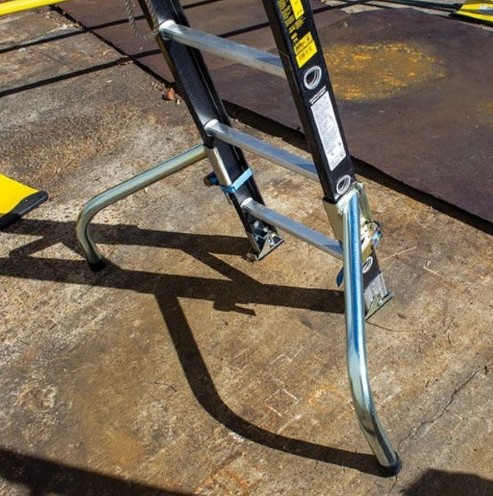
According to data from the Centers for Disease Control and Prevention (CDC), ladder-related falls account for over 300 deaths and more than 130,000 emergency room visits in the United States every single year. The shocking part? Over 50% of extension ladder slide-outs happen at the base, not because the top slipped.
Early in my career as a field contractor, I learned this lesson the hard way. I was working on a two-story residential fascia board when a sudden micro-shift at the base sent adrenaline surging through my veins. The ladder didn’t fall, but that two-inch kick-out felt like an earthquake at 18 feet up.
When I climbed down, I inspected the base section and discovered a hardened, slick rubber shoe packed with dried clay. That terrifying moment completely changed how I look at vertical safety. It all comes down to two square inches of contact area: your extension ladder feet.
The Physics of Base Stability: Why Your Ladder Feet Matter
To understand vertical safety, think of your extension ladder as a dynamic mechanical lever. When you stand on the top rungs, your body weight generates a massive vector of downward force and outwards thrust at the bottom.
If the friction force between the ground surface and your ladder base is lower than that outward thrust, a violent base kick-out occurs.
                  [ WALL SURFACE ]
                        |  /
                        | /
                        |/  <-- Working Load (Body + Gear)
                        /
                       /|
                      / |
                     /  |
                    /   |  <-- Outward Thrust Force
 [ GROUND ] -------O----+-------------------------
                   ^
         [ EXTENSION LADDER FEET ]
Your extension ladder feet act like specialized high-performance tires on a sports car. They are the sole interface responsible for transferring thousands of pounds of static and dynamic load safely into the ground.
Anatomy of High-Performance Extension Ladder Feet
Not all ladder shoes are created equal. Modern extension ladders utilize multi-action safety shoes engineered for specific terrain types and surface compositions.
| Feature / Type | Primary Surface Compatibility | Key Mechanism | Best Application |
| Swivel Safety Shoes | Concrete, Asphalt, Wood, Mud | Dual-pivoting base plate | General contracting, exterior siding |
| Heavy-Duty Rubber Treads | Smooth Concrete, Tile, Sealed Wood | High-friction elastomer compound | Interior remodeling, commercial maintenance |
| Spur Plates (Cleats) | Grass, Dirt, Gravel, Packed Snow | Steel penetrating teeth | Tree trimming, roofing prep, yard work |
| Adjustable Leveling Feet | Sloped Ground, Uneven Steps | Telescope or ratchet mechanism | Stairwells, hillside residential properties |
Dual-Action Swivel Feet: The Industry Workhorse
Most professional-grade fiberglass and aluminum extension ladders come equipped with swivel extension ladder feet. These shoes feature a heavy-duty rubber pad on the flat bottom for hard surfaces, hinged on a steel pivot pin.
When you flip the shoe forward, it exposes sharp metal pick-teeth known as spur plates. These teeth bite directly into soft earth, gravel, or ice to establish a rock-solid mechanical anchor.
Understanding Surface Mechanics and the 4-to-1 Rule
The mechanical grip of your extension ladder feet relies directly on setting the correct pitch angle. Safety standards established by ANSI (American National Standards Institute) and OSHA dictate the 4-to-1 rule.
-
The Math: For every 4 feet of vertical working height to the top support point, set the base 1 foot away from the wall.
-
The Angle: This creates an optimal climbing angle of approximately 75.5 degrees.
If you set the base too far out, you drastically increase the horizontal vector force, overwhelming the friction coefficient of your ladder shoes and inviting a slip. Set it too steep, and the ladder can tip backward when you step onto the upper rungs.
How to Inspect and Maintain Your Extension Ladder Feet
In my ten-plus years on job sites, I have seen perfectly good extension ladders rendered dangerous simply because the owner ignored routine foot maintenance. Incorporate this 60-second inspection routine before every climb:
-
Check for Elastomer Hardening: Over time, outdoor exposure hardens the rubber tread. Hard rubber turns slick and loses its friction coefficient on smooth concrete. If you cannot indent the tread slightly with your thumbnail, replace the shoe.
-
Inspect Tread Depth: Just like automotive tires, your ladder shoes feature deep groove patterns to evacuate water and dirt. If the tread pattern is worn smooth, the foot must be replaced.
-
Examine Pivot Hardware: Ensure the swivel pin moves smoothly without excessive side-to-side wobble. Lubricate rust-prone pivot points with silicone spray—never grease, which attracts dirt.
-
Clean Out Trapped Debris: Caked mud, small pebbles, or dried paint stuck inside the tread grooves prevent full rubber-to-surface contact.
Expert Advice: Pro Tips and Hidden Warnings from a 10-Year Pro
Pro Tip: The Dual-Surface Flip TechniqueWhen working on soft turf or garden beds, never rely on flat rubber pads. Pull the spring-loaded lock, pivot the extension ladder feet 90 degrees until the steel spur plates point down, and push the teeth into the soil with your boot before stepping onto the first rung.
-
Hidden Warning #1: The Slick Garage Floor TrapSmooth, sealed, or epoxy-coated concrete garage floors are top-tier hazard zones for ladder kick-outs. Dry drywall dust or saw dust on top of epoxy acts like tiny ball bearings beneath your rubber ladder shoes. Always sweep the surface spotless or use a rated ladder mat stop before setting up your base.
-
Hidden Warning #2: Never Mix and Match Aftermarket PartsIf your extension ladder feet wear out, replace them with original manufacturer parts designed specifically for your ladder’s duty rating (e.g., Type IA or Type IAA). Installing generic or mismatched shoes can alter the pivot geometry and compromise ANSI structural compliance.
Final Pre-Climb Base Safety Checklist
Before putting your boots on the first rung, run through this mental checklist:
-
Ground Assessment: Is the footing surface solid, level, and free of loose oil, algae, or drywall dust?
-
Foot Orientation: Are the swivel shoes locked flat for hard surfaces, or flipped to spur teeth for soft ground?
-
Angle Check: Did you apply the 4-to-1 angle rule to balance friction and load distribution?
-
Tread Verification: Are the rubber soles soft, deep-grooved, and free from caked mud?
Protect Your Foothold
Vertical safety is not about luck; it is an engineering discipline that starts at ground level. By maintaining, inspecting, and correctly deploying your extension ladder feet, you transform an intimidating task into a controlled, safe operation.
Have you ever experienced a frightening ladder slip, or do you have a specific setup challenge on your job site? Leave a comment below or ask a question—I personally reply to help you keep your DIY and professional projects rock-solid!