Imagine waking up at 3:00 AM to a rhythmic thud-clack sound coming from your kitchen. You freeze, thinking a burglar has breached your back door. You rush downstairs, heart pounding, only to find a very confused, very mangy stray raccoon staring at you from beside your cat’s food bowl. He didn’t pick a lock; he simply walked through that $20 plastic flap you installed last summer.
In my ten years of retrofitting homes, I’ve seen this “uninvited guest” scenario more times than I can count. Most homeowners view a pet entrance as a simple convenience, but in the modern era of the connected home, a traditional flap is essentially a gaping hole in your security perimeter.
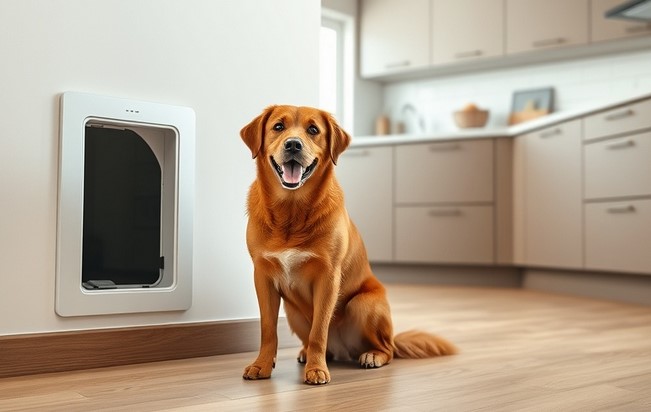
That is where the Smart Pet Door enters the conversation. It’s no longer just a hole in the wall; it’s a sophisticated gatekeeper that bridges the gap between pet freedom and residential airtight security.
The Security Flaw You’ve Been Ignoring
When I consult on home improvement projects, I tell my clients to think of their home like a computer network. Your front door has a deadbolt (the firewall), your windows have sensors (the antivirus), but that old-school pet flap? That’s a wide-open “guest” login with no password required.
Traditional flaps aren’t just an invitation for wildlife. A standard large-breed dog door is often big enough for a small human to reach through and unlock your main door handle. We are talking about a significant structural vulnerability disguised as a convenience for Fido.
The Smart Pet Door fixes this by shifting from a “passive” barrier to an “active” one. It stays physically locked until a verified “key”—usually a microchip or a Bluetooth tag—approaches. It’s the difference between leaving your front door wide open and installing a biometric scanner.
How a Smart Pet Door Actually Works: The RFID Revolution
If you’re new to this technology, don’t let the “Smart” label intimidate you. I like to use the Office Badge Analogy: Think of your pet like an employee at a high-security firm. They don’t just push the door open; they “badge in” using a chip.
-
Microchip Recognition: Most modern units sync directly with the ISO-standard microchip already implanted in your pet by the vet.
-
RFID Collar Tags: If your pet isn’t chipped, a small Radio Frequency Identification (RFID) tag on their collar acts as the digital key.
-
Active Locking Bolts: Unlike gravity-fed flaps, a Smart Pet Door utilizes motorized locking pins that physically prevent the flap from being pried open by external force.
In my experience, the technical reliability of these chips has skyrocketed. A decade ago, you might have had a “lag” where the pet stood there waiting for the door to wake up. Today, the low-latency sensors trigger the unlock before your dog even touches the flap with their nose.
Why Integration is the Future of Home Improvement
When we talk about “Smart Facility Integration,” we are talking about making your home work as a single, cohesive unit. A high-end Smart Pet Door doesn’t just let the dog out; it talks to your entire house.
1. Curfew Mode and App Control
Through a dedicated smartphone app, I’ve helped homeowners set “Digital Curfews.” You can program the door to allow “In-Only” access after 6:00 PM. This ensures your cat is safely inside before the coyotes or cars become a threat, all without you having to manually chase them down.
2. Activity Monitoring as a Health Diagnostic
This is an “expert insight” many people miss: The data from your Smart Pet Door is a health goldmine. If your app notification shows your dog is heading out 15 times a day instead of the usual 4, it might be an early sign of a urinary tract infection or anxiety. I’ve had clients thank me for suggesting a smart door simply because it helped them catch a vet issue early.
3. Integration with Security Cameras
Some premium models can trigger your outdoor CCTV cameras the moment the pet door is activated. If someone—or something—attempts to tamper with the flap, you get a push notification and a video clip instantly.
Installation Deep-Dive: Wall vs. Door Mounts
As a pro with a decade of sawdust in my boots, I can tell you that the “where” is just as important as the “what.” You have two primary paths for your Smart Pet Door installation.
The Door Mount (Beginner Friendly)
This involves cutting a hole directly into your existing wood, metal, or PVC door.
-
Pros: It’s faster, easier to “undo” if you replace the door, and usually requires fewer tools.
-
Cons: If you have a glass-paneled door, it becomes a nightmare of custom glazing costs.
The Wall Mount (Intermediate/Expert)
This requires cutting through drywall, insulation, and exterior siding or brick.
-
Pros: It keeps your main entrance looking clean and allows you to place the door in a more “hidden” location (like a laundry room) for better security.
-
Cons: You must be extremely careful of electrical wiring and stud placement.
-
LSI Keyword Alert: Always use a wall tunnel kit to ensure a weatherproof seal and to prevent moisture from rotting your home’s structural framing.
Expert Advice: The “Hidden” Technicalities
💡 Pro Tip: The Weatherproofing Factor
Many people buy a Smart Pet Door for security but forget about Thermal Efficiency. A cheap door will leak air like a broken window. Look for models with a dual-pane flap or “Extreme Weather” ratings. In a 100-degree summer or a sub-zero winter, a poorly sealed pet door can add $20 a month to your utility bill.
⚠️ Hidden Warning: The “Raccoon Tail” Problem
Cheaper smart doors use a timer to lock the door once the pet passes. However, if the lock engages too slowly, a clever intruder (like a stray cat) can follow your pet through the door before it clicks shut. This is called “tailgating.” When shopping, look for doors with adjustable stay-open times or “fast-close” motorized mechanisms.
Maintenance Checklist for Longevity
A Smart Pet Door is an electronic appliance living in a harsh environment. To keep your residential security at its peak, follow this 6-month maintenance routine:
-
Sensor Cleaning: Use a microfiber cloth to wipe the infrared or RFID sensors. Dust and pet hair can “blind” the door.
-
Battery Management: If your door isn’t hardwired, replace the batteries before they die. Most apps will give you a “low battery” warning—don’t ignore it, or your pet might end up locked out in the rain.
-
Seal Inspection: Check the rubber gaskets for cracking. A cracked seal ruins the acoustic insulation and lets in drafts.
Technical Specifications Comparison
| Feature | Entry-Level Smart Door | Professional Integrated System |
| Connectivity | Bluetooth Only | Wi-Fi / Zigbee / Matter |
| Power Source | AA Batteries | Hardwired with Battery Backup |
| Locking Mechanism | Single Plastic Latch | Multi-point Steel Bolts |
| User Capacity | Up to 10 Pets | Unlimited / Cloud Sync |
| Weather Rating | Single Flap | Triple-Shield Insulated |
Final Thoughts: Security Without Sacrifice
Upgrading to a Smart Pet Door is about reclaiming your peace of mind. It’s about knowing that your home’s perimeter is secure, your energy bills are stable, and your pets have the freedom they deserve without turning your kitchen into a wildlife sanctuary.
In the world of home improvement, we often say that the best upgrades are the ones you stop noticing because they work so seamlessly. A well-integrated smart door is exactly that—a silent sentry that keeps the bad out and lets the good in.
Are you planning to install your pet door in a wall or a door? If you’re worried about hitting a wire or a pipe during a wall installation, let me know your home’s construction type in the comments—I’d be happy to walk you through the structural precautions!